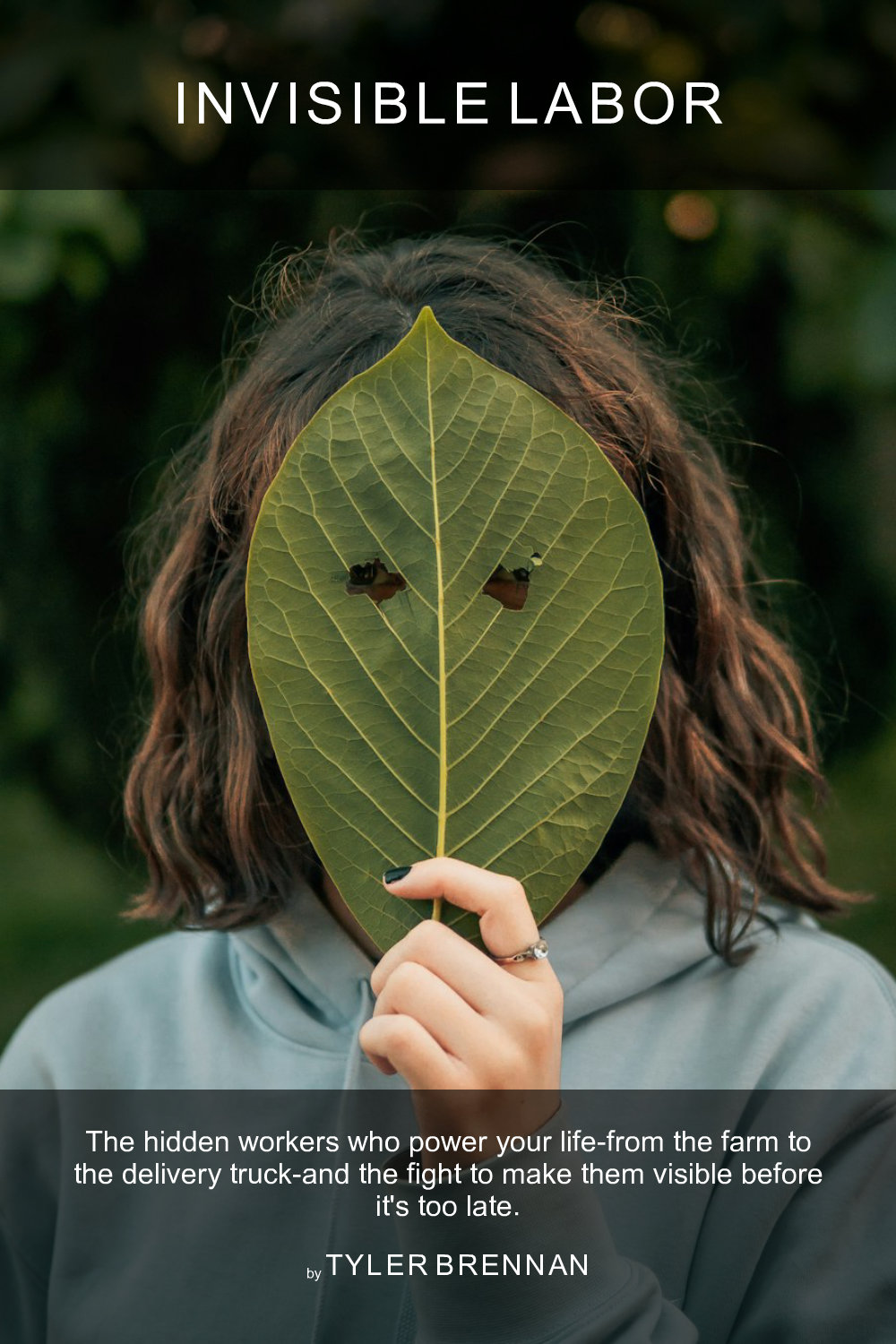
The hidden workers who power your life—from the farm to the delivery truck—and the fight to make them visible before it's too late.
🔒Secure checkout via Stripe
✓30-day money-back guarantee — not right for you? Full refund, no questions asked.
Fall Festival Sale
$9
About this book
Every time you order a meal, buy a shirt, or simply flush a toilet, you are relying on a vast network of workers that most people never think about. Their labor is invisible—but it is the foundation of everything we call modern life. In this sweeping, deeply researched narrative, Invisible Labor pulls back the curtain on the people who make our world run: the women who once carried laundry from tenements to the river, the migrants who rise before dawn to pick our produce, the cooks who feed us at our busiest moments, the drivers and warehouse workers who deliver our packages in twenty-four hours. These workers have been deliberately rendered invisible—their skills downgraded, their bodies worn out, their stories erased—so that the rest of us can enjoy clean clothes, fresh food, and cheap goods without asking how they got there.
But invisibility is not an accident. It is a choice. Drawing on archival research, oral histories, and new reporting from coast to coast, journalist and historian Mara Lawson shows how the devaluation of these jobs was written into the fabric of industrial capitalism, upheld by racial and gendered hierarchies, and accelerated by the gig economy. She introduces us to the stubborn, resourceful workers who have always found ways to resist—through unions, co-ops, strikes, and everyday acts of solidarity—and reveals the hidden cost of our convenience: burnout, injury, inequality, and a society teetering on the edge of collapse.
From the laundresses of the Gilded Age to the essential workers of COVID-19, this is a history of the people who hold up the ceiling—and a warning about what happens when we let it crack. With a reporter's eye for detail and a storyteller's gift for heart, Lawson weaves together intimate portraits, surprising friendships, and dangerous confrontations, creating an urgent, compassionate case for a new way of seeing—and valuing—the work that keeps us alive.
By the end, you will never look at a grocery store shelf, a delivery notification, or a hamburger the same way again. But this book is not just an awakening; it is a call to action. It shows that recognizing invisible labor is the first step to transforming it—and that if we want a future worth living in, we must start by honoring the hands that built it.
Reader Reviews
Emily Thomas
★★★★★I couldn't put this down. The opening with Maria's 4:47 a.m. routine broke my heart and opened my eyes—I'll never complain about a slow elevator in a hotel again. Lawson's storytelling is so vivid that I felt the bleach on my own hands and the ache in Maria's back. This is the kind of book that changes how you see the world, and I've already bought three copies for friends. Essential reading.
Brian Flores
★★★★★Really powerful and well-researched—the chapter on gig workers hit close to home for me, since I used to deliver packages. The only reason I'm not giving it five stars is that some of the historical sections dragged a bit, especially in the middle. But Lawson's portraits of workers like Maria are unforgettable, and it's made me rethink that 'convenience' really means. Worth your time.
Anna Smith
★★★★★This book is a wake-up call wrapped in a hug. Maria's story—the tiny details like the torn gloves and the telenovela on her phone—made me feel like I was right there with her. Lawson doesn't just explain invisible labor; she makes you feel it in your bones. I finished it in two days and immediately started looking for ways to support worker co-ops in my area. Everyone should read this.
Elizabeth Flores
★★★★★I loved the modern sections about COVID-19 and the gig economy—Lawson's reporting is top-notch and genuinely infuriating. My only gripe is that I wished for a bit more on the global south, since the book is very US-focused. But the core message about how our convenience is built on others' exhaustion really landed. I'll be recommending it to my book club, but with a warning: it will make you angry.
Robert Garcia
★★★★★This is the most important book I've read in years. The way Lawson weaves together the laundresses of the Gilded Age and today's hotel cleaners is brilliant—I never expected to see so clearly how history repeats itself. Maria's chapter alone is worth the price; I felt every single room she cleaned. It's not just an exposé, it's a call to action, and I've already started talking to my local union about volunteering. Five stars, no question.
James Wright
★★★★★Solid, eye-opening read. The narrative is gripping, especially the scenes of Maria's daily grind—that 'hospital corners' detail stuck with me. I knocked off a star because I found some of the archival sections a bit dense, and I wanted more direct solutions rather than just the call to action at the end. Still, it's a timely and compassionate book that made me think twice about ordering so much stuff online.
Donald Moore
★★★★★I'll admit I didn't expect to be moved by a book about labor, but Lawson's writing is surprisingly warm and human. Maria's story—especially that moment with the sleeping guest—felt so real and uncomfortable. My caveat is that the tone sometimes veers toward preachy, and I wish it had more concrete policy proposals. But it's a necessary read, and I've already started noticing all the 'invisible' workers around me. Recommend.