The Complete Handbook of Candied & Chocolate Covered Fruit
A practical reference for selectors, bakers, chocolatiers, and confectionery professionals: sourcing, storing, enrobing, and troubleshooting real product.
★★★★★4.0 · 2 reviewsby Alumigogo Books
non-fiction
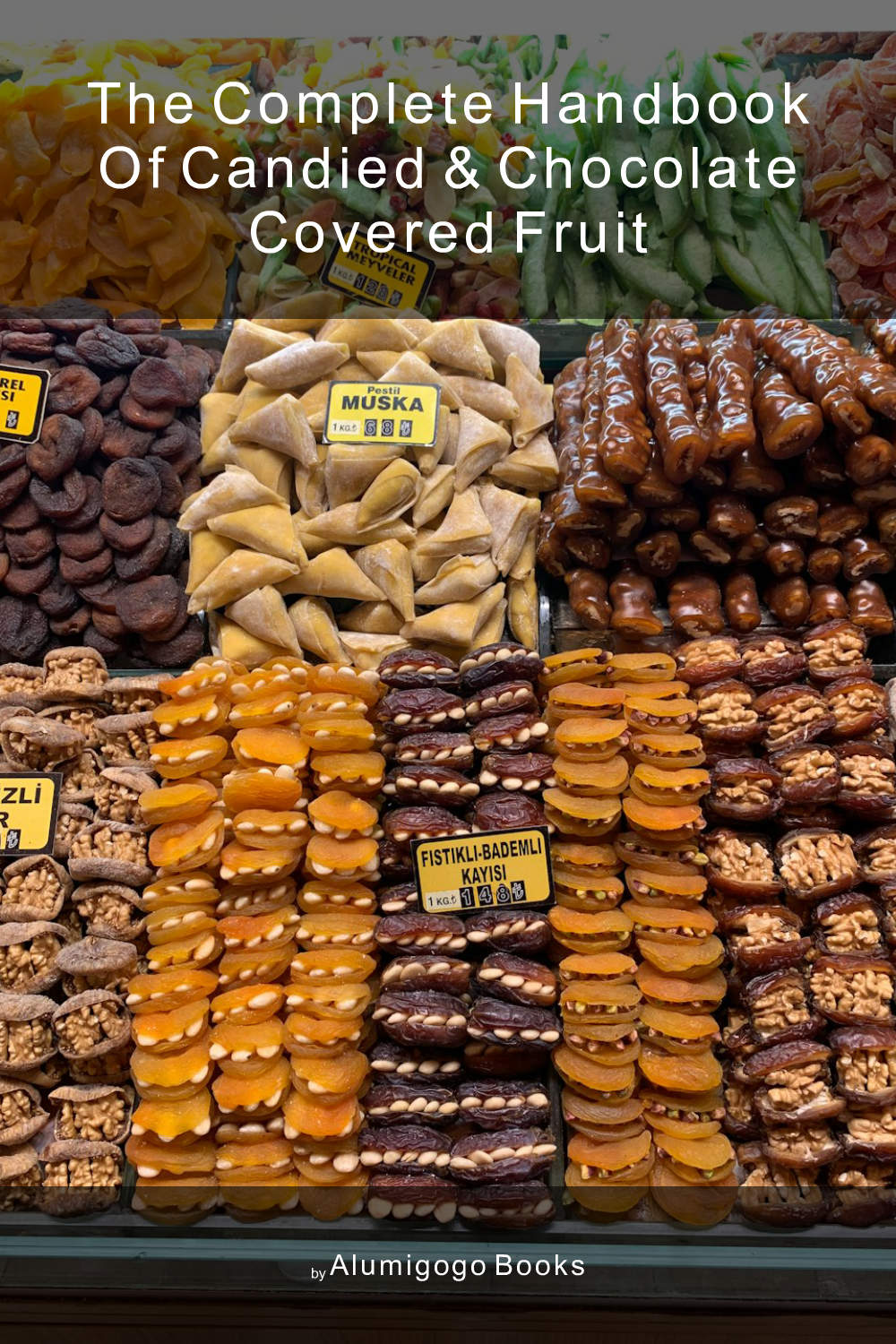
The Complete Handbook of Candied & Chocolate Covered Fruit
A practical reference for selectors, bakers, chocolatiers, and confectionery professionals: sourcing, storing, enrobing, and troubleshooting real product.
★★★★★4.0 · 2 reviewsby Alumigogo Books
non-fiction
Specify it, store it, enrobe it, fix it. The practical reference for commercial and serious candied fruit work.
🔒Secure checkout via Stripe
✓30-day money-back guarantee — not right for you? Full refund, no questions asked.
Fall Festival Sale
$9
About this book
Candied and chocolate covered fruit sits at the intersection of two demanding food technologies—sugar preservation and cocoa-butter crystallization. Get either wrong and you get sticky, weeping, or bloomed product that misses the shelf-life window your business depends on. This handbook is written for the person who actually has to make it work: the baker who needs uniform citron dice for panettone, the chocolatier who wants a freeze-dried raspberry interior that stays crisp under a 35% dark coating, or the specialty buyer who must compare a $9/lb glacé cherry against a $22/lb one and know exactly what the price difference buys.
Each chapter moves from measurable specifications to practical procedures. You will find a full breakdown of grading criteria—sugar solids, water activity, fruit size uniformity, coating fat composition—and how those numbers translate into real shelf-life and texture outcomes. The book includes a detailed enrobing and dipping chapter that covers tempering curves, viscosity management for different coating types (dark, milk, white, and compound), and the specific behavior of different fruit interiors from high-moisture glacé to low-moisture dried. Maintenance and troubleshooting chapters cover reversible issues like sugar bloom, fat bloom, and sticky surfaces, including a step-by-step diagnostic flowchart that distinguishes a storage problem from a coating-fat problem.
It also includes a pragmatic survey of the commercial landscape: how major suppliers position their products, what private-label and co-packing actually involve, and what regulatory changes are on the horizon (including labeling rules for added sugar and new moisture-control ingredients). The final chapters provide a glossary of the specific terms you will see on spec sheets and a set of answers to the most common buying and handling questions the authors have fielded from their own work in commercial confectionery.
Reader Reviews
Jessica Ramirez
★★★★★Finally a reference that treats this like a technical discipline. I have been buying glacé fruit for our bakery for years and mostly guessing based on supplier samples. The chapter on specifications alone—actual Brix ranges and what they mean for moisture migration—justified the price. I also appreciated the troubleshooting section on sticky surfaces; it saved a batch of candied orange that I would have scrapped. The discussion of coating fat composition and its effect on shelf life is the clearest thing I have read on this subject. Not a fluffy page in the book.
Stephanie Adams
★★★★★It's a solid, information-dense reference and I learned a lot about water activity and bloom. That said, it reads more like a textbook than a handbook. I was hoping for more ready-to-use comparison tables of major suppliers and their actual product specs, but the book describes supplier categories generically and tells you what to ask for rather than listing the answers. The troubleshooting flowcharts are useful, but the layout is a bit dry. If you are a professional who wants to build your own knowledge base, it is worth it. If you wanted a quick buyer's cheat sheet, you will need to do more homework yourself.