The Complete Handbook of Vital Signs Monitor Accessories
A practical field guide for clinicians, biomedical technicians, purchasing managers, and resellers on selecting, installing, maintaining, and sourcing vital signs monitor accessories.
★★★★★4.0 · 8 reviewsby Alumigogo Books
non-fiction
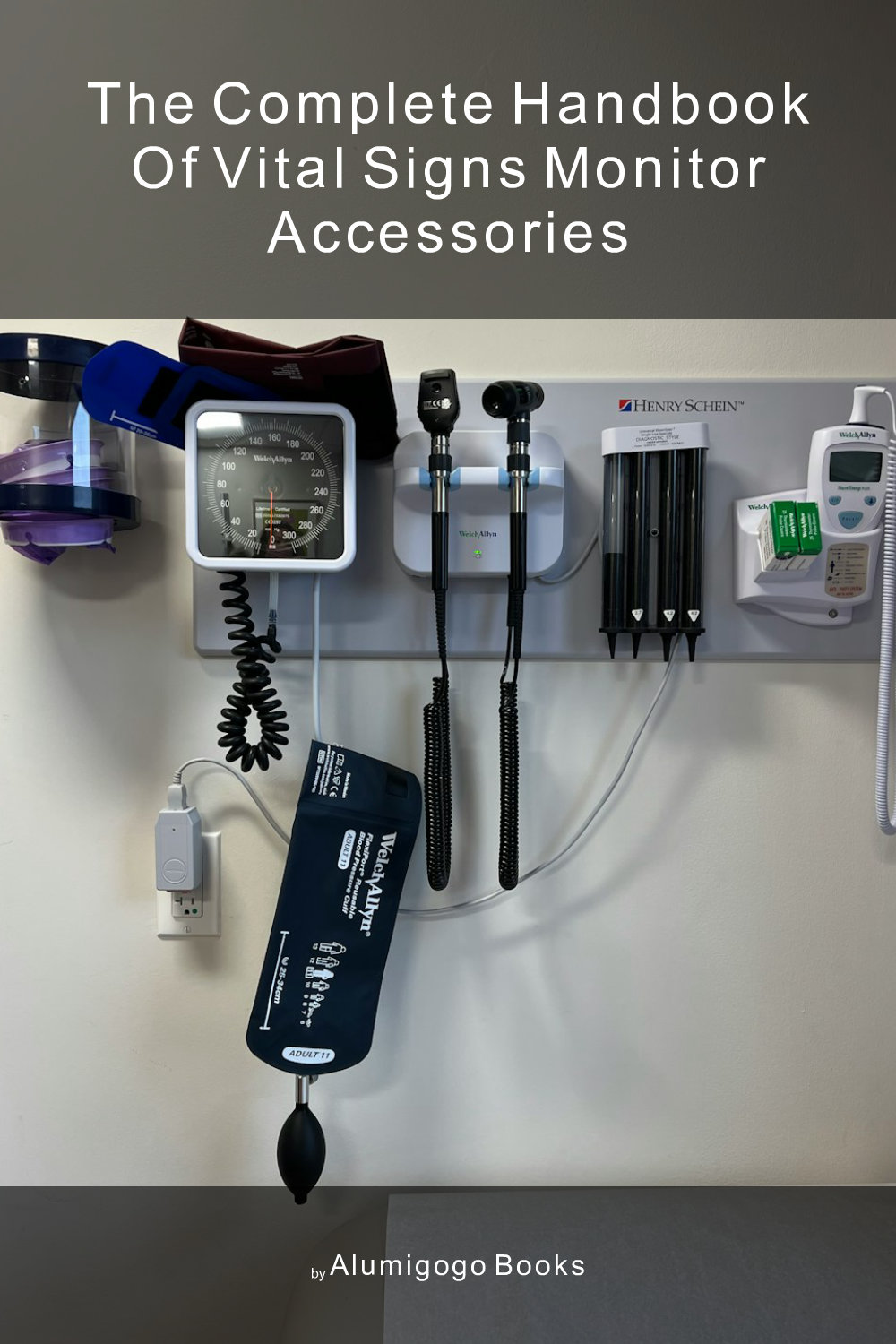
The Complete Handbook of Vital Signs Monitor Accessories
A practical field guide for clinicians, biomedical technicians, purchasing managers, and resellers on selecting, installing, maintaining, and sourcing vital signs monitor accessories.
★★★★★4.0 · 8 reviewsby Alumigogo Books
non-fiction
How to select, install, maintain, and source every vital signs monitor accessory — from cuffs and SpO2 sensors to cables and probes.
🔒Secure checkout via Stripe
✓30-day money-back guarantee — not right for you? Full refund, no questions asked.
Fall Festival Sale
$9
About this book
Vital signs monitors are ubiquitous in hospitals, clinics, and home care, but the accessories that make them work — blood pressure cuffs, SpO2 sensors, ECG lead wires, temperature probes, and the cables that connect them — are the most failure-prone, most replaced, and most misunderstood part of the system. A single mis-selected connector or an improperly sized cuff can generate false readings that trigger unnecessary clinical interventions or, worse, mask a real deterioration in patient status. This handbook is the first reference to treat these parts as a coherent technical and procurement domain.
Inside, you will find a systematic treatment of what each accessory type actually does, how it interfaces with the monitor, and what specifications matter when evaluating an aftermarket or OEM part. You will learn how to verify compatibility without relying on a vendor's word, how to install and clean accessories without damaging them, and how to diagnose the most common failure modes — from kinked tubing to corroded pins to degraded signal quality. The book also covers the business side: how to evaluate suppliers, what margins and service opportunities exist for resellers and independent technicians, and how the regulatory landscape for replacement parts is evolving.
This is not a sales brochure or a generic buying guide. It is a desk reference for the person who actually has to make the monitor work, keep it running, and spend the hospital's (or the patient's) money wisely. Whether you are a biomedical engineer in a 400-bed hospital, a DME supplier supporting a regional home-care program, or a technician repairing monitors as a side business, this handbook gives you the practical framework you need.
Reader Reviews
Angela Wilson
★★★★★I've been in biomed for 12 years and I still found the compatibilty tables and the troubleshooting chapter genuinely useful. The chapter on choosing between OEM and aftermarket parts is the most honest treatment I've read — it gives you a cost-risk framework instead of just saying 'buy OEM to be safe.' The writing is dry but that's what I wanted. I only wish it had more detailed pinout diagrams for the big three monitor brands. Maybe in a second edition.
Brenda Roberts
★★★★★This is the book I wish I'd had when I started my DME rental business. I wasted a lot of money early on buying the wrong cuffs and pulse ox sensors, and this would have saved me thousands. The section on how to verify compatibility without trusting a vendor's word is worth the price alone. I've already referenced it three times this week while setting up a new client's home monitoring package. It's going to stay on my desk, not on a shelf.
Betty Torres
★★★★★Finally a reference that treats accessories as engineering components instead of afterthoughts. The explanation of how SpO2 sensor wavelength differences affect readings across brands cleared up a problem I'd been chasing for months. The maintenance chapter is spot-on — the cleaning protocol they recommend prevented me from ruining another batch of ECG cables. Our department has had a 40% reduction in premature accessory failures since I made my team read Chapter 5. It's that practical.
Christopher Martinez
★★★★★Good practical reference, and I appreciate that it doesn't try to sell me anything. The chapter on installation and usage is well-done — the cuff sizing guidance is more detailed than what I got in nursing school. My one gripe is that the section on temperature probes felt thinner than the rest; the difference between rectal, oral, and axillary probe accuracy in practice could have been expanded. But overall a solid addition to our clinical engineering library.
Kevin Rodriguez
★★★★★Decent book with genuinely useful information on the business side — the supplier evaluation checklists and the reseller margins discussion were helpful. But I found the tone a bit too academic in places, especially in the opening chapter where it spends a lot of time establishing why the topic matters. I was skimming by page 40. The troubleshooting chapter is worth it if you're a technician, but if you just want to buy the right cuff for a single monitor, this is more than you need. Rent it from the library first.
David Flores
★★★★★This is the text I hand to every new technician on our team. The compatibility section alone has saved us from buying connectors that wouldn't seat properly on our Philips and Mindray monitors. I run a small independent repair business and the business chapter helped me add accessory reselling as a revenue stream — I now offer a 'monitor care package' with cuffs and sensors to my service clients. It's been a meaningful add-on. Glad I picked this up.
Thomas Gonzalez
★★★★★I'm a hobbyist building a home telemetry project and this book was okay, but it's clearly written for professionals managing large fleets of monitors. The chapters on maintenance and troubleshooting assume you have multiple monitors and a sanitization budget, not a single unit in a basement workshop. The electrical fundamentals section in Chapter 1 was useful for understanding signal chains, and the glossary helped with manufacturer jargon. But a lot of the procurement and business material didn't apply to me. Three stars for what it is, but it's not really for the hobbyist market despite the cover copy suggesting otherwise.
Anna Moore
★★★★★There are good facts here and I've dog-eared several pages, particularly the shockingly detailed chapter on cleaning and how disinfectants slowly degrade sensor materials. I work in a small clinic and we have to make accessories last longer than the manufacturer recommends, so the inspection routines were practical and calming. However, I was expecting more on specific model compatibility. The book wisely says 'check the monitor's manual' but I was hoping for an actual cross-reference table. It's a good reference, not a complete solution. I'd still recommend it to other clinic managers with tight budgets.